
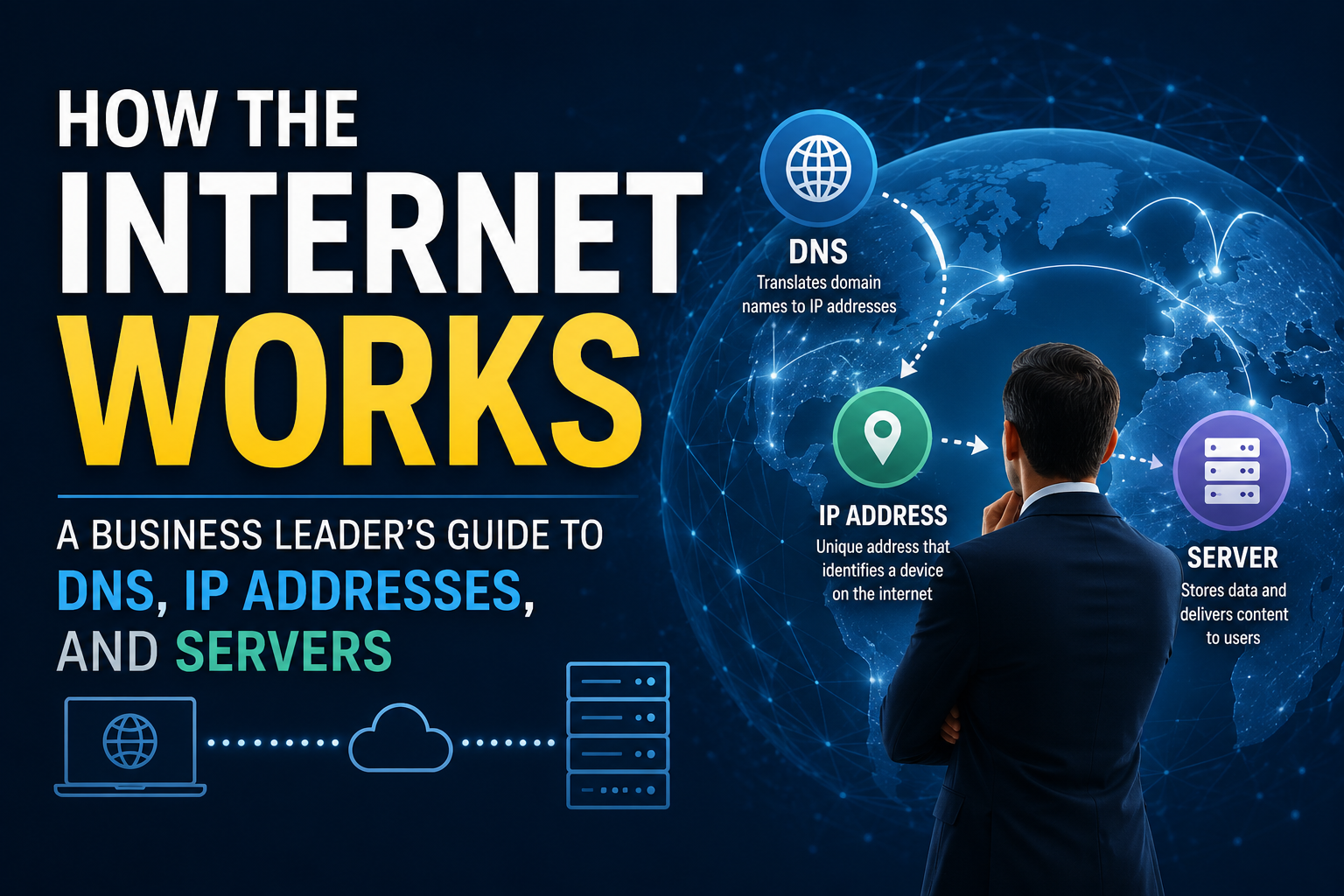
How the Internet Works: A Business Leader’s Guide to DNS, IP Addresses, and Servers
In the modern enterprise, digital infrastructure is no longer solely the domain of the IT department. For executives and business leaders, understanding the foundational mechanics of the internet is a prerequisite for making informed decisions regarding digital transformation, cybersecurity, and customer experience.
When a client types your company’s URL into their browser, a complex, high-speed exchange of data routing occurs within milliseconds. To navigate and leverage this digital ecosystem, leaders must understand its three core pillars: IP Addresses, the Domain Name System (DNS), and Servers.
Here is an executive breakdown of how the internet functions and why it directly impacts your bottom line.
1. The Digital Coordinates: Understanding IP Addresses
Every device connected to the internet—from your enterprise cloud architecture to a customer’s smartphone—requires a unique identifier to send and receive data. This is the Internet Protocol (IP) address.
Think of the internet as a massive global logistics network. If you want to send a physical contract to a vendor, you cannot simply write their company name on the envelope; you need their exact street address, city, and postal code. An IP address serves this exact function in the digital realm.
- IPv4: The traditional routing format, structured as four sets of numbers separated by periods (e.g., 192.168.1.1).
- IPv6: The modern, expanded standard. Created to accommodate the explosion of Internet of Things (IoT) devices, it utilizes a longer alphanumeric format to ensure the global network never runs out of unique addresses.
The Business Implication: IP addresses tie directly into cybersecurity and localized marketing. By understanding IP geolocation, businesses can route users to region-specific server nodes, dynamically adapting currency, language, and compliance standards (such as GDPR) based on the user’s location.
2. The Global Directory: The Role of DNS
While computers communicate flawlessly using numeric IP addresses, human beings do not memorize strings of numbers efficiently. We remember brand names. This cognitive gap is bridged by the Domain Name System (DNS).
DNS acts as the internet’s decentralized contact book. When a user types www.yourbusiness.com into a browser, the DNS translates that human-readable domain name into the machine-readable IP address where your website resides.
- The Lookup Process: Your browser queries a DNS resolver, which searches global registries to find the exact IP address associated with your domain.
- DNS Caching: To speed up this process, networks remember (or “cache”) recent DNS lookups so repeat visitors connect almost instantly.
The Business Implication: A slow or compromised DNS routing process directly translates to high bounce rates and lost revenue. Optimizing your DNS resolution time—often by upgrading to premium Anycast DNS services—is one of the highest-ROI technical investments a company can make to improve page load speed and search engine rankings.
3. The Destination: Servers and Data Delivery
Once the DNS has provided the correct IP address, the user’s browser sends a request to the final destination: the Server.
A server is a high-powered, purpose-built computer designed to process requests and deliver data over a network 24/7. When the browser’s request arrives, the server retrieves the necessary files (HTML, images, web applications) and transmits them back to the user’s screen.
- Web Servers: Handle the structural delivery of website files.
- Database Servers: Store and retrieve dynamic user data, such as customer profiles and inventory levels.
The Business Implication: Whether you are hosting a lightweight corporate blog or a resource-heavy SaaS platform, the geographic location and bandwidth capacity of your servers dictate your application’s performance. Relying on a single centralized server creates latency for international users. Distributing your assets across a Content Delivery Network (CDN)—a network of edge servers deployed globally—ensures that data travels the shortest physical distance possible, drastically reducing load times.
4. The Millisecond Journey: Bringing It All Together
To synthesize these concepts, consider the exact sequence of events when a prospective client visits your site:
- The Request: The user types your domain name into their browser.
- The Translation: The browser asks the DNS to translate the domain into an IP address.
- The Connection: The browser uses that IP address to locate your company’s server.
- The Delivery: The server processes the request and sends the website data back to the user’s IP address, rendering the page on their screen.
Understanding these foundational elements empowers business leaders to stop viewing IT infrastructure as a static cost center. Instead, by optimizing DNS routing, managing IP protocols, and scaling server architecture strategically, you transform your digital foundation into a core competitive advantage.